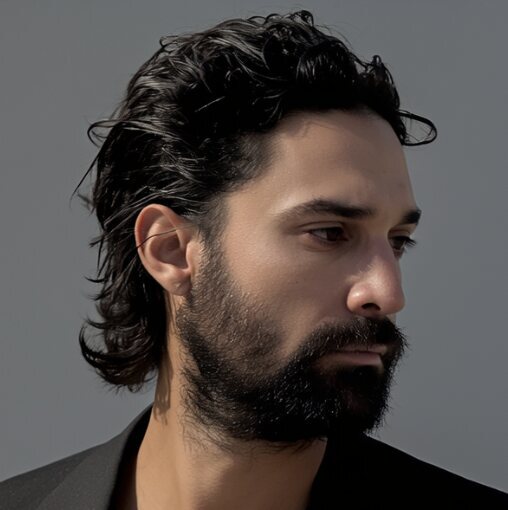
Amos Le Blanc is a Canadian filmmaker whose body of work spans music video, commercial, brand campaign, and feature narrative. He took Gold at the Cannes Young Director Award, was named Director of the Year at the MMVA, has directed campaigns for Bud Light with Anomaly and for Tim Baker, Foodpanda, Tiger Beer, and Mercedes through his production company dream inc., and is in development on Neverenders, the upcoming A24 feature reported to attach Timothée Chalamet and Marion Cotillard. He also founded The Creator Class, a documentary platform interrogating the economics of independent authorship, and consults on UN initiatives concerning migrant labour and corruption in developing countries.
Tsulgi commissioned this conversation because we wanted a director's eye on the question we work inside every day. How does a hotel actually become a story, and what does it take to film a place so that the place remains itself.
AMOSEvery film I have ever cared about treats location as a character with a temperament. Place has memory built into the geography. A room remembers the people who have stood in it. A coastline remembers what the light did to it at four in the afternoon in some other century. As a director you are not building a setting, you are listening for what the place already knows, then arranging the frame so it can speak.
The shortcut is to dress a location to match a script. The longer route, the one that gives you a film instead of an advertisement, is to write the script the location wants. That is a slower brief but the result lasts. Audiences feel the difference. They cannot always name it, but they feel it.
AMOSBrand work taught me discipline. You learn to deliver a narrative inside thirty seconds, sometimes inside fifteen, and you learn that constraints are usually the friend of clarity. The Bud Light campaign with Anomaly, the Living Room piece, is a useful example. The brief was about belonging. The film was about a chair, a doorway, a particular slant of light. The brand recedes when the human truth is present, and that is when the brand actually lands.
With dream inc. we built a model that could move from a Tim Baker performance shoot in Newfoundland to a Tiger Beer spot in Bangkok to a Mercedes piece without losing voice. The trick is to hire collaborators who can hold a tone across geographies. Photography directors, production designers, sound designers who understand that taste is not a style, taste is a posture toward the material.
AMOSThe Gold was for The Denial, a piece I made for Fridays For Future. We were trying to film climate inaction as a domestic posture rather than a political one. Quiet rooms, polite people, a refusal that sounds reasonable until you replay it in your head. Cannes recognising it gave the work a passport.
What changed practically was the inbound. The phone calls came from a different category of producer. What changed personally was the standard I held myself to in pre production. Once a festival has put a stamp on your name you can no longer pretend the next piece does not need the same care. The award is not a credential, it is a contract you signed in public.
AMOSNeverenders is the feature I have been writing toward for years. A24 are the right partner because they understand the economics of singular voice. The piece sits inside a world I cannot describe in a single line, which is, I think, the only kind of story worth taking to a hundred and ten minutes. We are still in development. I will not speak to casting on the record beyond confirming that the conversations have been generous and the people in the room are people I have admired for a long time.
The move from commercial and music video to feature narrative is less of a leap than people imagine. The grammar is the same. What changes is the metabolism. A music video lives at the speed of a hook. A feature lives at the speed of a relationship. You have to learn to write across attention spans, and you have to trust an audience to sit still while you put the pieces in place.
AMOSHotels at the level Tsulgi works with are essentially small civilisations. Someone has spent decades thinking about how a guest moves from the threshold to the bed, what a corridor should sound like at dusk, which trees should be visible from which window. That is not marketing material. That is film material. The job of a director is to render that intelligence in image and sound so the audience can feel the architecture of the hospitality, not merely look at it.
The best hotel films I have seen, and the ones I want to make, treat the property the way a serious documentary treats a community. With patience. With long lenses where it matters and short lenses where it matters. With sound design that is doing as much work as the picture. With an editorial point of view that is not afraid of silence. If a brand allows that approach, the result is not an advertisement, it is a small film. And a small film can travel for a decade.
That is the brief I would take, every time.
Director and cinematographer working across narrative, music video, and brand. Cannes Young Director Award Gold for The Denial with Fridays For Future. MMVA Director of the Year. Selected credits include the Bud Light Living Room campaign with Anomaly, Tim Baker's Eighteenth Hole, the EXOTIC QUIXOTIC PRACTICE trilogy via dream inc. for EXOTIC QUIXOTIC, and Valentina Ploy's Camera Roll under dream inc.
Founder of dream inc., the production company through which he has directed work for Bud Light, Foodpanda, Tiger Beer, and Mercedes. Founder of The Creator Class, a documentary platform on independent authorship. UN consultant on migrant labour and corruption in developing countries. Currently in development on Neverenders, an A24 feature reported to attach Timothée Chalamet and Marion Cotillard.